
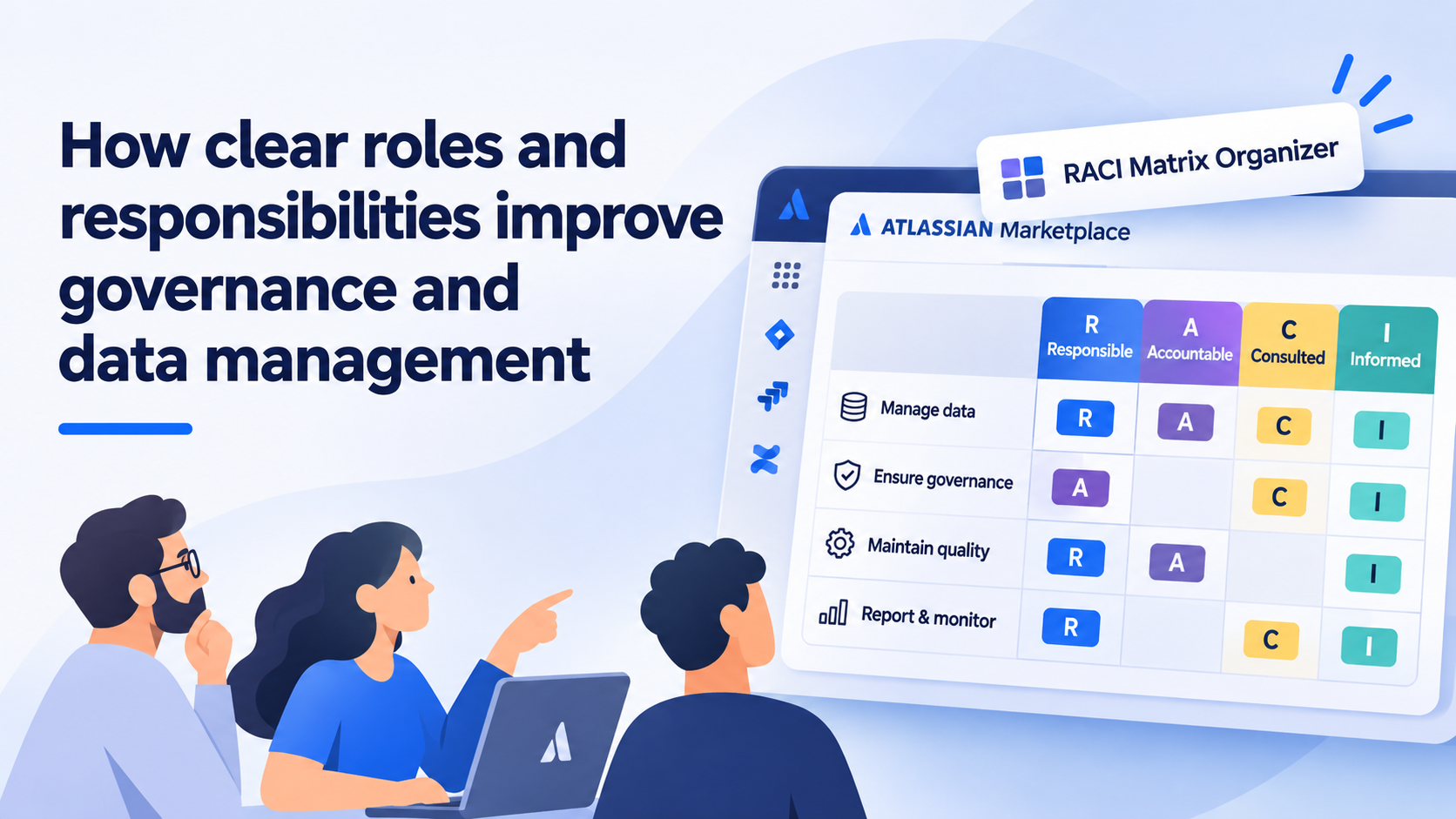
How clear roles and responsibilities improve governance and data management
TL;DR
Good governance starts with clear ownership. When teams know who performs a task, who makes decisions and who needs to be involved, they can work more consistently and avoid unnecessary delays. A RACI matrix helps define these responsibilities across projects, business processes and data management activities. With RACI Matrix Organizer for Confluence, teams can create, manage and share responsibility matrices directly in Confluence.
Why clear ownership matters for governance and data management
Most organizations have documented processes, established workflows and plenty of information in Confluence. Yet one question can still cause confusion: who is actually responsible?
A task might involve several departments, but nobody knows who has the final say. A process may be documented, but the people responsible for reviewing or approving it are not clearly identified. Sometimes, everyone assumes someone else will take care of it.
These gaps can lead to delayed decisions, inconsistent information and tasks that fall between teams.
The challenge becomes even more noticeable in projects. From the start of a project, team members need to understand their responsibilities, decision-making authority and dependencies. Without this clarity, approvals can become bottlenecks, and important deliverables may be overlooked.
Data management faces similar challenges. If nobody clearly owns a dataset, who validates its accuracy? Who resolves inconsistencies? Who approves changes to important business information?
Better governance starts with clear ownership, defined decision-making responsibilities and processes that people can follow consistently. This is especially important for cross-functional projects and initiatives where multiple teams share responsibility for the outcome.
What is a RACI matrix, and how does it support governance?
A RACI matrix is a responsibility assignment tool that maps people or roles to specific tasks, activities and decisions. It helps everyone understand their part in a process without having to guess or chase colleagues for clarification.
RACI stands for four roles:
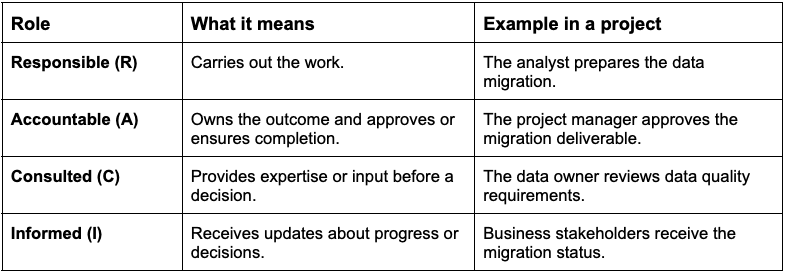
For example, when launching a new reporting process, a data analyst might prepare the report, a department manager might approve it, a data owner might validate the underlying information, and other stakeholders might receive the final results.
A RACI matrix makes these relationships visible.
It is not a complete governance framework, nor does it automatically ensure compliance. Instead, it supports governance by documenting responsibilities, clarifying decision-making and making assignments easier to review.
How RACI matrices help improve data quality and data management
Clear responsibility assignments make data-related work easier to coordinate. They help organizations establish who maintains information, who reviews its quality and who has the authority to approve changes.
Establishing clear data ownership
Organizations rely on datasets, reports, customer records and other information assets every day. Each needs appropriate ownership.
A RACI matrix can identify who maintains a dataset, who approves changes and who should be consulted when issues arise. This reduces uncertainty when information needs attention.
Improving data quality through defined responsibilities
Imagine that customer records contain conflicting information across business systems. Without clear ownership, the issue might remain unresolved because every team expects another department to investigate it.
A RACI matrix can assign responsibility for investigating discrepancies, correcting records, validating the results and approving changes.
The matrix does not fix data quality issues by itself. It helps ensure that the right people know what they need to do.
Standardizing data management processes
Recurring activities often involve several people and departments. These include data validation, reporting, access reviews and periodic updates to business records.
Documenting responsibilities helps teams follow the same process more consistently. It also makes it easier to identify gaps when a workflow changes.
Supporting governance and compliance processes
Organizations often need to demonstrate how internal controls and approval processes are organized. A RACI matrix can document who performs control activities, who approves decisions and who receives updates.
This improves transparency and makes responsibilities easier to review. However, a RACI matrix should complement formal policies, controls and compliance procedures, not replace them.
Practical examples of RACI in governance and data management
Project planning and delivery
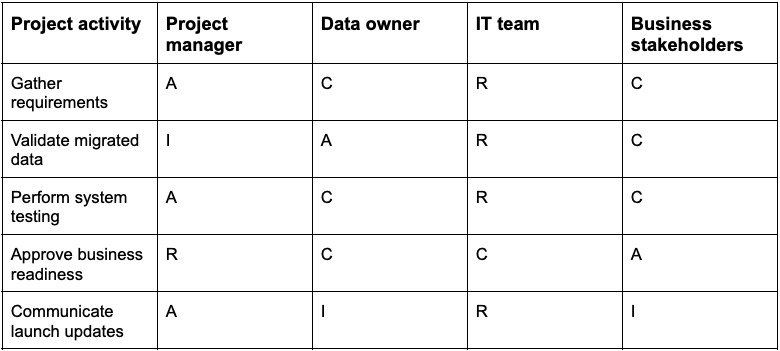
Consider a project to introduce a new customer relationship management system. The project involves IT, operations, data management and business stakeholders.
A RACI matrix can clarify who gathers requirements, who validates migrated data, who approves the migration, who performs testing and who signs off on the launch.
Defining these roles at the beginning helps project members understand their responsibilities before work gets underway. It also makes dependencies and approval points easier to identify as the project progresses.
Data quality management
A team discovers inconsistent customer information across business systems. The matrix identifies who investigates discrepancies, who approves corrections, which stakeholders should be consulted and who needs to know when the issue is resolved.
Data access and permissions
An organization introduces regular access reviews. Responsibilities can be assigned for initiating reviews, checking access requirements, approving changes and communicating the results.
Reporting and policy management
For recurring business reports, a RACI matrix clarifies who prepares the report, validates the data, approves publication and receives the results.
For internal policies, it can define who drafts the documentation, reviews it, approves the final version and communicates changes.
Across these scenarios, RACI provides a clearer picture of ownership. It supports better governance practices without replacing the systems, procedures or controls needed to carry them out.
Best practices for creating and maintaining a RACI matrix
A useful RACI matrix should be easy to understand and practical enough for people to use regularly.
- Define the process or project first. Establish what the matrix covers and what outcome it should support.
- Break the work into specific activities. Include important tasks, decisions, approvals and handovers.
- Distinguish responsibility from accountability. The person doing the work may not be the person approving the outcome.
- Involve relevant stakeholders. Agree on assignments with the people who will follow them.
- Keep the matrix manageable. Avoid unnecessary roles and overly detailed task lists.
- Make it accessible. Store the matrix where relevant team members can find it alongside related documentation.
- Control editing access. Decide who can update assignments and who only needs viewing access.
- Review it regularly. Revisit responsibilities when projects, processes, team structures or ownership change.
- Archive outdated matrices. Preserve useful historical information without confusing it with current assignments.
A RACI matrix should be a maintained governance resource, not a document created once and forgotten.
Managing RACI matrices in Confluence
Confluence provides a shared space for project documentation, policies and process knowledge. However, when teams manage several projects and business processes, keeping responsibility matrices organized can become difficult.
Separate spreadsheets and manually maintained documents can create version-control problems. Team members may struggle to identify the latest matrix or find out who can update it.
Managing RACI matrices directly in Confluence helps keep responsibility assignments close to the documentation people already use. Teams can organize matrices for different projects and workflows, manage access and make relevant information available on Confluence pages.
This is particularly useful for project managers, process owners, data governance teams and Confluence administrators who need a more structured approach to responsibility management.
How RACI Matrix Organizer for Confluence supports these workflows
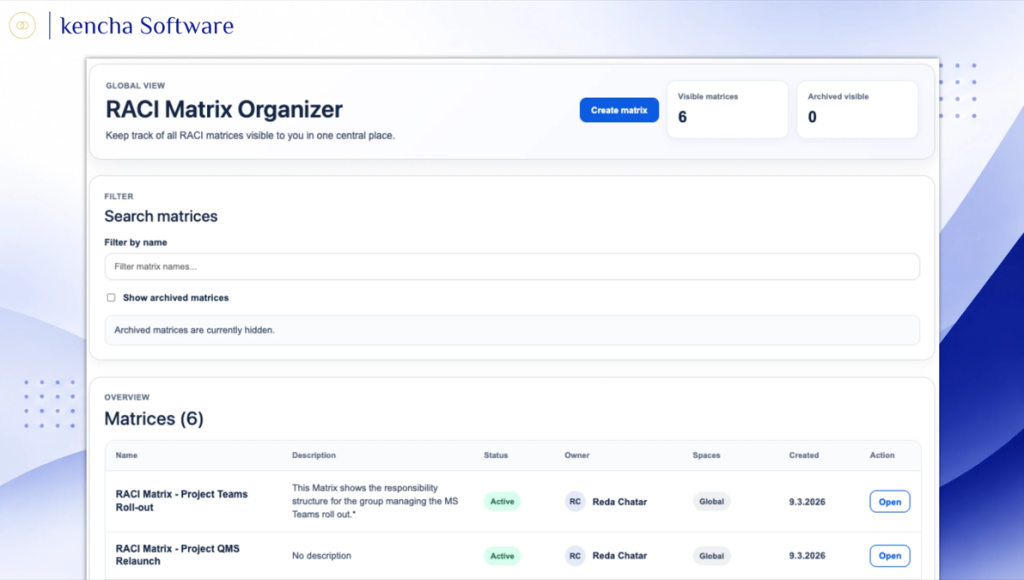
RACI Matrix Organizer for Confluence helps teams create, manage and share responsibility matrices within Confluence.
Instead of maintaining disconnected spreadsheets, teams can manage their RACI matrices alongside their existing project and process documentation.
Key capabilities include:
- Create multiple RACI matrices: Organize responsibility assignments for different projects, processes and governance activities.
- Structure tasks within each matrix: Document the activities that need clear ownership, with additional task information.
- Track task status and due dates: Make task progress and deadlines easier to follow.
- Manage permissions: Assign Owner, Editor and Viewer access at the matrix level to support controlled editing and visibility.
- Display matrices on Confluence pages: Use the app's macro to make relevant responsibility information available alongside existing documentation.
- Reorder tasks: Adapt matrix structures as project plans and workflows evolve.
- Archive matrices: Preserve historical responsibility structures while keeping outdated matrices separate from active ones.
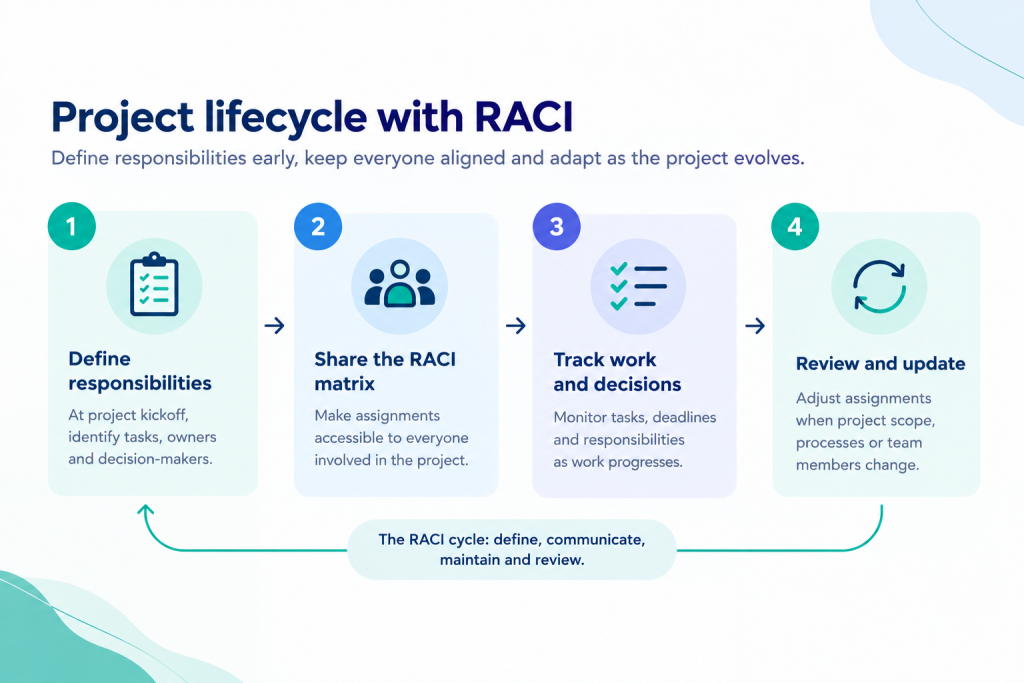
For project teams, these capabilities are useful from the beginning of the project lifecycle. Responsibilities can be documented early, shared with the people involved and maintained as plans change.
For governance and data management teams, the same approach helps keep ownership assignments accessible and easier to review.
The app supports transparency and coordination. Its value ultimately depends on teams defining responsibilities carefully and keeping their matrices up to date.
Common mistakes to avoid when implementing RACI
Even a well-designed matrix can lose its value if it is not implemented thoughtfully.
Watch out for these common mistakes:
- Creating a matrix before defining the underlying process or project.
- Confusing the Responsible and Accountable roles.
- Leaving important activities without an accountable owner.
- Assigning too many people to every task.
- Treating RACI as a replacement for detailed procedures or formal controls.
- Failing to update assignments when responsibilities change.
- Allowing uncontrolled edits to important governance documentation.
- Maintaining several versions without identifying the current one.
The goal is not to document every possible interaction. It is to give people enough clarity to understand their responsibilities and move work forward.
FAQs
What is a RACI matrix, and how does it work?
A RACI matrix maps tasks or decisions against four roles: Responsible, Accountable, Consulted and Informed. It clarifies who performs the work, who owns the outcome and who needs to participate or receive updates.
How does a RACI matrix support data governance?
It documents responsibility for data ownership, validation, approvals, access reviews and other data-related activities. This makes accountability more transparent but does not replace a complete data governance framework.
How can clear ownership improve data quality?
Clear ownership helps identify who should validate information, investigate discrepancies, approve corrections and maintain records. This reduces the risk of unresolved issues caused by unclear responsibilities.
What is the difference between data ownership and data accountability?
Data ownership concerns responsibility for a particular data asset and its appropriate management. Data accountability refers to being answerable for decisions or outcomes related to that data. The exact distinction depends on an organization's governance model.
How can teams use RACI for project management?
Project teams can define responsibilities at the beginning of a project, including requirements, approvals, testing, deliverables and handovers. The matrix can then be reviewed as the project evolves.
How often should a RACI matrix be reviewed?
Review it whenever responsibilities, project scope, team structures or processes change. Periodic reviews are also useful for identifying outdated assignments.
Can you create and manage RACI matrices in Confluence?
Yes. RACI Matrix Organizer for Confluence allows teams to create and manage multiple matrices, track task status and due dates, control matrix-level permissions, display matrices on Confluence pages and archive outdated matrices.
What is the difference between a RACI matrix and a data governance framework?
A data governance framework defines broader policies, standards, decision-making structures and controls for managing data. A RACI matrix is a practical tool for clarifying who is responsible for specific activities within that framework.
Make responsibility clearer across your organization
Good governance requires more than documented policies and well-defined processes. It also depends on people understanding who owns the work, who makes decisions and how responsibilities are maintained over time.
RACI matrices provide a practical way to establish clarity across projects, business processes and data management activities.
If your team uses Confluence to manage project knowledge and internal documentation, explore RACI Matrix Organizer for Confluence on Atlassian Marketplace to see how you can organize responsibility assignments in one shared workspace.
About the Author:

Anahit Sukiasyan is an Atlassian Certified Professional and Community Champion, recognized for her dedication to fostering collaboration, innovation, and knowledge-sharing within the global Atlassian ecosystem. With a strong background in IT Service Management, she has extensive hands-on experience with Jira, Jira Service Management, Confluence, Trello, and Jira Product Discovery, working across both Cloud and Data Center environments. Anahit specializes in end-to-end Jira project configuration, tailoring workflows, automation, and reporting to align with diverse business needs and improve operational efficiency.
Beyond her technical skills, Anahit is deeply committed to building and nurturing communities. Being an organizer of the Atlassian Community in Yerevan, she actively connects professionals, facilitates learning opportunities, and empowers users to get the most out of Atlassian tools.