
Confluence Governance at Scale: How Space Templates Bring Structure to Your Knowledge Base
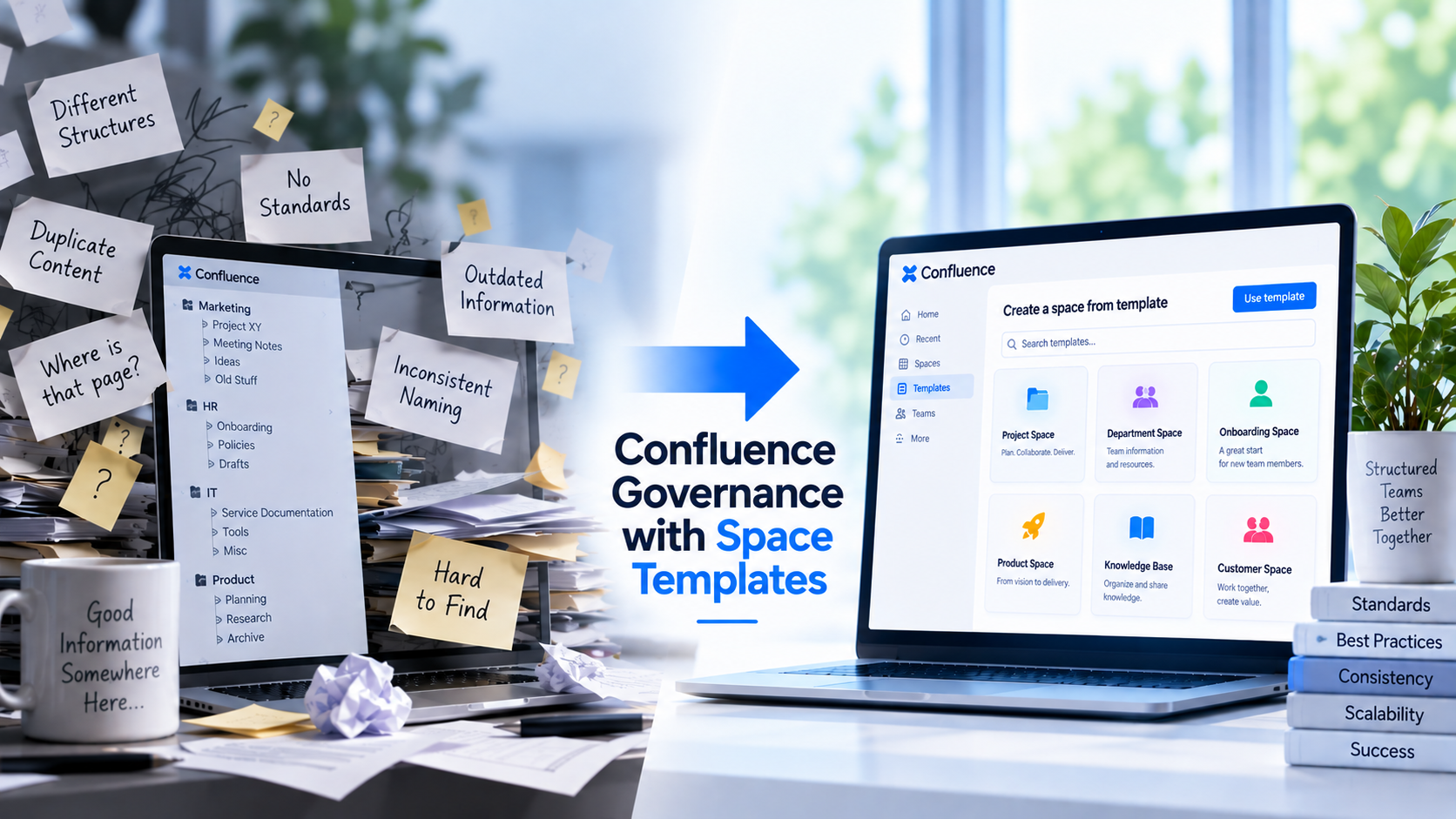
How do you keep Confluence flexible while ensuring teams follow consistent standards? As organizations grow, inconsistent space structures, duplicated work and different documentation practices can quickly turn a valuable knowledge base into a difficult-to-navigate information landscape.
A structured governance approach helps organizations solve this challenge without limiting how teams collaborate. With reusable space templates and Space Clone Manager for Confluence, companies can turn proven structures into repeatable standards — helping teams create consistent, well-organized Confluence spaces from day one.
From Confluence Chaos to Clarity: Why Structure and Governance Matter
Confluence often starts with a simple idea: give teams one place to create, share, and find knowledge.
And it works.
But as an organization grows, so does its Confluence environment. More teams create spaces, more projects generate documentation, and more people develop their own ways of organizing information.
Before long, a common challenge appears: everyone is using Confluence, but everyone is using it differently.
One department structures its space by projects. Another organizes content by teams. New employees receive a carefully designed onboarding space, while another department starts with an almost empty one. Important information exists, but finding and understanding it becomes increasingly difficult.
The problem is not Confluence itself. The challenge is creating enough structure to keep information consistent without taking away the flexibility that makes Confluence valuable.
This is where governance and standardization become essential.
The Real-Life Challenge: When Every Team Builds Its Own Confluence
Imagine a company with 20 departments.
Each department needs a Confluence space. Without a common approach, every team creates its space independently.
Marketing builds sections for campaigns, brand guidelines and planning. HR creates onboarding pages and policies. IT documents services and processes. Project teams create completely different structures depending on who happens to set up the space.
Individually, each space may work perfectly well.
Across the organization, however, several problems start to emerge.
Employees need to learn a new structure every time they enter another space. Important pages may be missing. Naming conventions differ. Permissions may be configured differently. New projects start by rebuilding structures that already exist elsewhere.
And when a best practice is developed in one team, there is no guarantee that another team will use it.
The organization has knowledge — but not necessarily a consistent knowledge architecture.
Governance Does Not Have to Mean More Bureaucracy
Governance sometimes sounds like adding approvals, restrictions and administrative work.
Good governance should do the opposite.
It should make the right way of working the easiest way of working.
Instead of providing employees with a 20-page document explaining how a new Confluence space should be structured, organizations can provide ready-to-use structures that already represent their standards.
This turns governance from documentation into experience.
A new project space, for example, could automatically start with:
- Project Overview
- Goals and Scope
- Team and Responsibilities
- Meeting Notes
- Decisions
- Requirements
- Risks
- Documentation
- Retrospective
Employees do not need to remember the standard. The standard is already part of the workspace.
That is a much more scalable approach.
Turning Successful Spaces into Reusable Blueprints
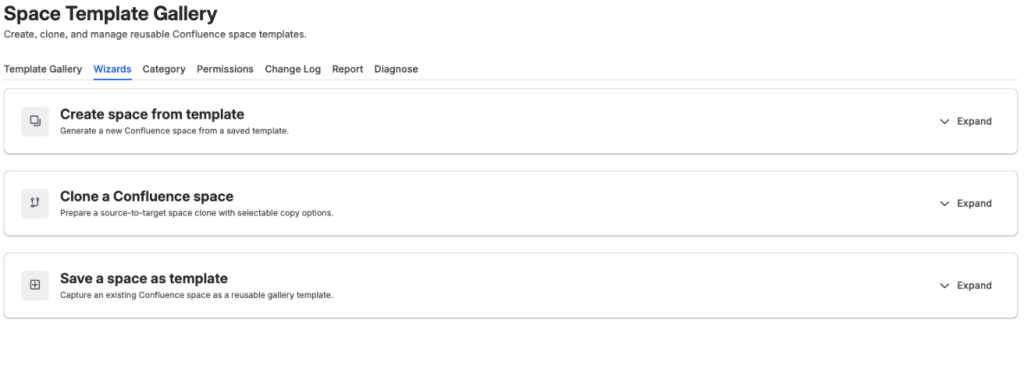
This is where Space Clone Manager for Confluence can support a structured approach to Confluence governance.
Instead of creating every new space from scratch, existing Confluence spaces can become reusable templates. Teams can take structures that already work and make them available as blueprints for future spaces.
A well-designed project space can become the standard project template. A successful onboarding space can become the foundation for future onboarding areas. The same principle can be applied to departments, customer documentation, product teams, quality management or internal initiatives.
Templates can then be organized in a central Template Gallery, helping users find the appropriate starting point for their use case.
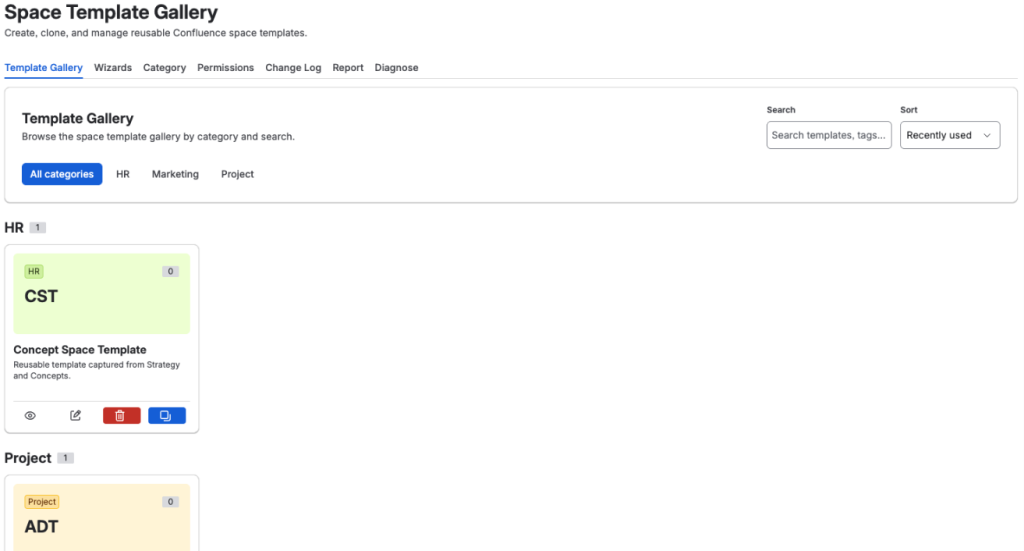
The result is simple: best practices become reusable instead of remaining isolated in individual spaces.
Standardization Without Losing Flexibility
One concern around standardization is that every team has different requirements.
That is true — and effective governance should recognize it.
The goal is not to make every Confluence space identical. The goal is to standardize the elements that should be consistent while leaving teams freedom where flexibility creates value.
Organizations could, for example, define different templates for:
Projects
A common project structure with objectives, stakeholders, decisions, risks and documentation.
Departments
A standard home for team information, responsibilities, processes and important resources.
Onboarding
A consistent starting point for new employees with company information, training materials and role-specific guidance.
Product Development
A structured environment for product vision, requirements, research, decisions and release documentation.
Customer or Partner Collaboration
A predefined information architecture designed around a repeatable collaboration model.
Instead of one rigid corporate template, companies can build a portfolio of approved structures for different business scenarios.
Five Benefits of Structured Confluence Governance
1. Faster Space Creation
Creating a useful Confluence space takes more than clicking “Create Space.”
Someone has to decide which pages are required, build the hierarchy, add initial content and configure the environment.
Reusable space templates reduce this repetitive setup work. Teams can start from an established blueprint and focus on their actual work rather than recreating infrastructure.
2. More Consistent Information
When spaces follow recognizable patterns, employees know where to look.
If every project contains a clearly defined area for decisions, risks or documentation, information becomes easier to navigate across teams.
Consistency reduces the cognitive effort required to understand how another team works.
3. Best Practices Become Scalable
Companies continuously develop better ways of working.
The challenge is distributing those improvements.
Templates provide a practical mechanism for turning successful approaches into repeatable standards. Instead of telling 50 teams how they should organize a space, organizations can give those teams a proven starting point.
4. Better Governance and Control
Not every user necessarily needs to manage corporate templates.
Space Clone Manager supports role-based access, allowing organizations to define who can access templates and who can manage template configurations. The app also provides logging around template usage and changes, supporting greater transparency and auditability.
This creates an important balance: users can benefit from standardized structures while designated owners maintain the standards behind them.
5. Easier Adoption and Onboarding
Standardization is also a user-experience improvement.
When employees move between projects, departments or business units, familiar structures help them orient themselves faster.
For new employees in particular, predictable information architecture can make Confluence significantly easier to understand.
Instead of asking, “Where does this team keep its information?”, users begin to recognize organizational patterns.
A Practical Governance Model
Technology alone does not create governance. Organizations still need to decide which standards make sense.
A practical approach can start small.
First, identify the types of Confluence spaces that are created repeatedly. Projects, departments, onboarding areas and product spaces are common examples.
Next, review successful existing spaces. Instead of designing standards entirely from theory, look at structures that teams already use effectively.
Turn the strongest examples into approved templates and assign clear ownership for maintaining them.
Then make those templates easy to discover. A categorized Template Gallery can help users select the right blueprint without needing to understand the governance model behind it.
Finally, review usage over time. Governance should evolve together with the organization. Templates that are heavily used can be improved, while structures that no longer reflect current ways of working can be updated or replaced.
The objective is not to create a perfect template once.
It is to create a sustainable system for continuously improving how organizational knowledge is structured.
From Individual Spaces to Organizational Knowledge
The biggest value of Confluence is not the number of pages an organization creates.
It is how effectively people can use the knowledge stored in those pages.
As Confluence grows, structure becomes increasingly important. Without it, every new team, project and department can add another variation to the information landscape.
With the right governance model, growth can have the opposite effect: each new space can reinforce established best practices.
Space Clone Manager for Confluence helps organizations make that transition by turning successful spaces into reusable templates, providing users with a central Template Gallery and supporting controlled template management through roles, logging and reporting. It can copy page hierarchies and homepage content as well as elements such as attachments, labels, internal links and, optionally, page restrictions.
The result is not simply faster space creation.
It is an opportunity to make Confluence more predictable, scalable and easier to navigate.
Because good knowledge management is not only about creating information.
It is about creating information in a way that others can understand, find and reuse.